Company Formation Denmark
Company Formation in Denmark
Our specialists assist you with company formation in Denmark, from the first idea to registration, so your business complies with Danish corporate law.

Our specialists will assist you in all matters relating to the setup of a company in Denmark, ensuring that your business complies with Danish corporate laws and regulations. We assist entrepreneurs from the first idea for the business entity through incorporation and post-incorporation requirements.
| Quick Facts | |
|---|---|
| Types of companies | Private limited company |
Minimum share capital for LTD Company | DKK 20,000 |
Minimum number of shareholders for Limited Company | 1 |
| Time frame for the incorporation | 4 working days |
| Corporate tax rate | 22% |
| Dividend tax rate | 27%, with a 22% reduced final rate in some cases. No withholding tax on dividends applies in case of the participation exemption. |
| VAT Rate | 25% standard rate and a 0% reduced rate for some goods and services. |
| Number of Double Taxation Treaties | 80 |
| Do you supply a Registered Address? | Yes |
| Local Director Required | No |
| Annual Meeting Required | Yes |
| Redomiciliation Permitted | Yes |
| Electronic Signature | Yes, in most cases (exceptions: notary, marriage contracts, certain real property rights transfers, etc.) |
| Is Accounting/Annual Return Required? | Yes, auditing can be optional in some cases. |
| Foreign-Ownership Allowed | Yes |
| Any Tax Exemptions Available? | Dividends received by Danish parent companies are generally tax exempt from the withholding tax. |
| Any Tax incentives Available? | Full deductions for patents in the year of acquisition and various research and development expenditure refunds. |
| Steps for Danish company formation | – choose suitable legal entity, – select available name, – submit necessary documents to Danish Business Authority, – complete tax registration with the Danish Tax Agency (Skattestyrelsen), etc. |
Corporate bank account required (YES/NO) | YES, you need a corporate bank account for company registration in Denmark. |
Minimum share capital for A/S | 400,000 DKK, but under certain conditions, it’s possible to pay only 100,000 DKK upfront. |
| Sole proprietorship – characteristics | – suitable for small investments, – requires a single member, – the member is fully liable for the company’s debts. |
| General required documents | – Article of Association, – proof of deposited capital, – directors/shareholders information, – address proof, – documents of incorporation, etc. |
| Shelf companies available (YES/NO) | YES |
| Tax return filing | Must be filed electronically within six months from the end of the accounting year. |
| Tax year | Any 12-month period |
| Employee registration | Employees must be registered with a private insurance company. |
| Subsidiaries allowed (YES/NO) | YES |
| Other available entities | – representative offices, – branches |
| Special permits and licenses | Industry-specific (hospitality, construction, healthcare, transportation, financial, etc.) |
| Other corporate taxes | – social security contributions, – stamp duty, – excise duty, – property tax, etc. |
| Benefits of opening a Danish company | – straightforward incorporation process, – access to the Nordic market, – business-friendly environment, – tax treaties & incentives, – skilled workforce, etc. |
| Additional services | – tax consultancy, – drafting contracts, – company liquidation, – intellectual property services, etc. |
What are the steps for registering a company in Denmark?
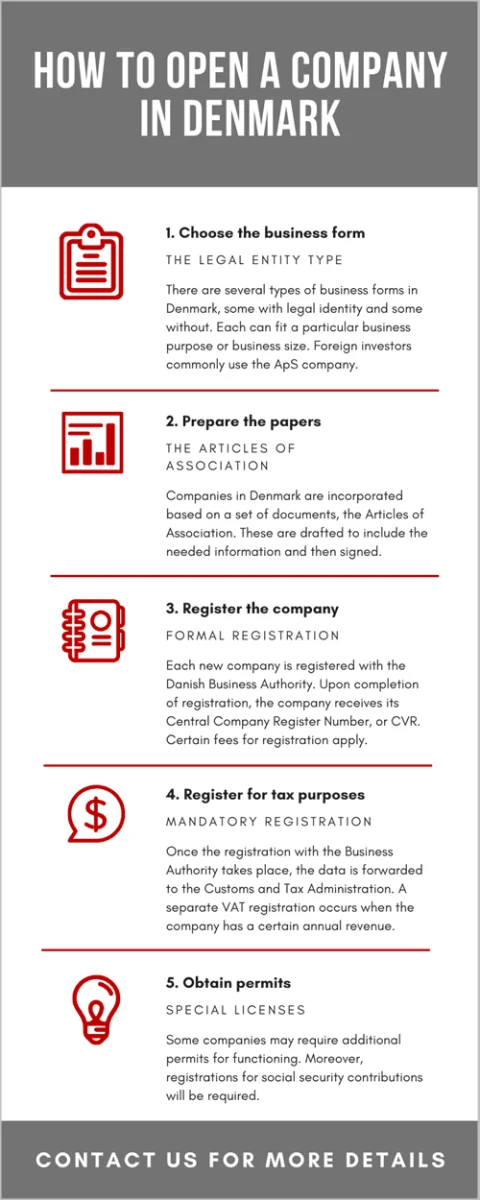
The steps for setting up a company in Denmark are briefly outlined in the list below:
- Choose a suitable type of legal entity: this is done by observing the size of the future business, its goals and objectives, along with the available capital for incorporation.
- Choose a unique business name and open a bank account: each company must have a unique business name and a bank account opened with one of the Danish banks.
- Actual company registration: once the company’s constitutive documents are complete, entrepreneurs submit all of them to the Danish Business Authority; each company is assigned a CVR number.
- Tax registration: after it’s registered with the Business Authority, a new company is also registered with the Danish Tax Agency (Skattestyrelsen).
You can also watch a short video on how to open a company in Denmark presented by our team:

Which are the costs of opening a company in Denmark?
Below, we list the most important costs, according to the type of company:
- Company formation services: from DKK 3,000 + VAT;
- Danish Business Authority registration fee: DKK 670;
- Minimum share capital for an ApS: DKK 20,000;
- Additional costs may apply for tax registrations, compliance procedures, shareholder agreements, legal assistance, and business address services.
Which documents are needed for starting a company in Denmark?
These documents vary depending on the selected business structure and the profile of the founders. Examples of the documents required include:
- Passport or identification documents of the shareholders and directors;
- Documentation that proves the residential address of the founders;
- Information about shareholders and beneficial owners;
- Name of the company;
- Nature of the business operations;
- Registered office address of the company in Denmark;
- Proof of share capital contribution.
What comes next after setting up a company in Denmark?
After the registration of the company in Denmark and issuance of the CVR number, further procedures might be required in order for the company to start its business operations. We also offer support in the following procedures:
- VAT registration;
- Employer registration;
- Tax on payroll registration;
- Import/export registration;
- Opening corporate bank account;
- Bookkeeping and accounting.
How does company taxation in Denmark work ?
The main taxes for companies in the country are the following:
- the corporate income tax (22% for companies in all other industries except for the financial sector, taxed at 26%, and upstream oil and gas income, taxed at 25% plus a 52% hydrocarbon tax);
- the withholding tax on dividends (can be subject to a reduced rate under an applicable double tax treaty);
- social security tax (approximately 10,000-12,000 DKK per employee per year);
- stamp duty as well as other taxes.
For further consultancy please feel free to contact our company formation specialists in Denmark.